Top Takeaways
blower motor replacement cost
Most blower motor jobs we run land between $300 and $900 total in parts and labor . The motor itself runs $50 to $450, labor adds $150 to $400, and emergency service adds another $100 to $200. The bigger question hiding in the price is whether the spend makes sense on the furnace it's going into.
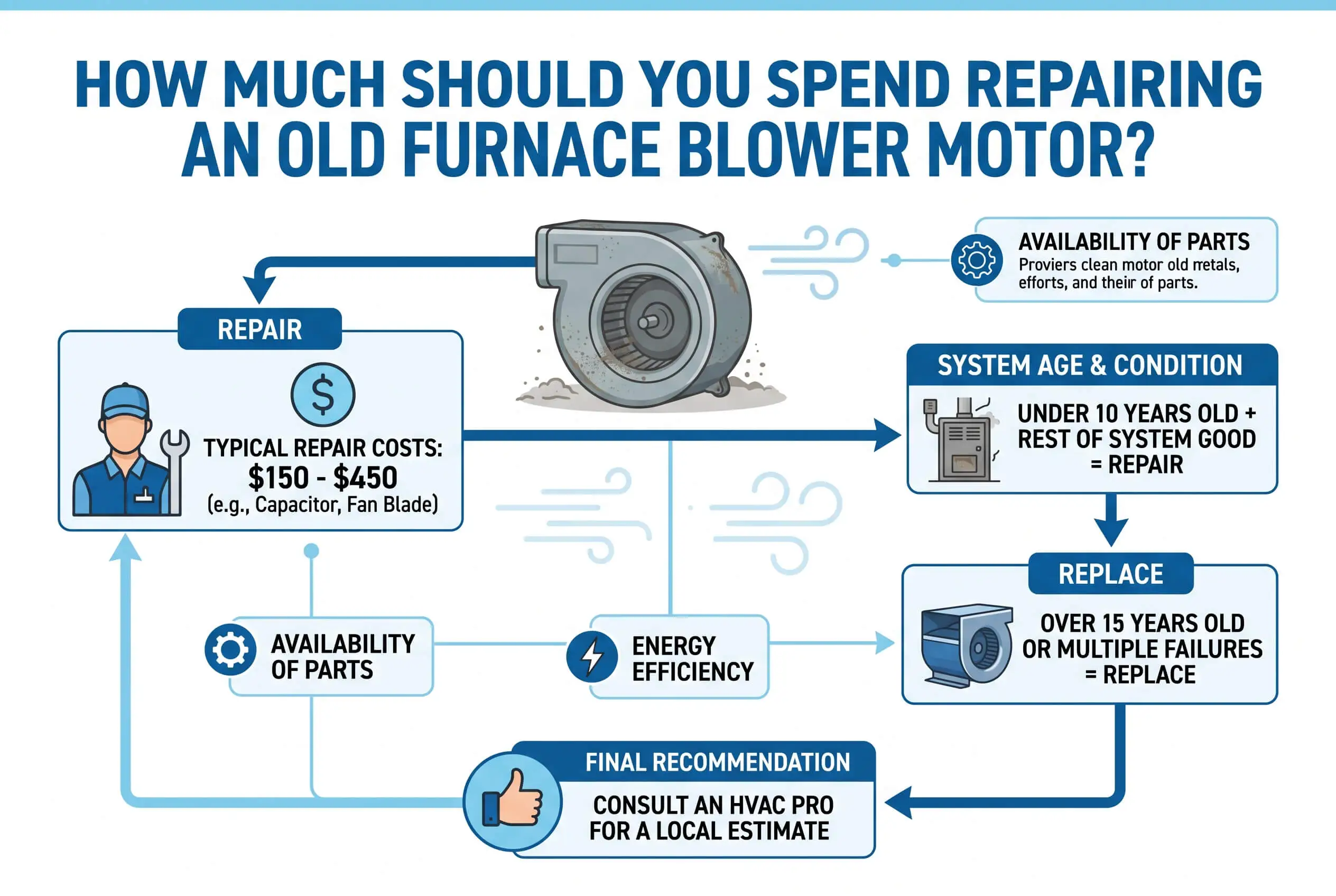
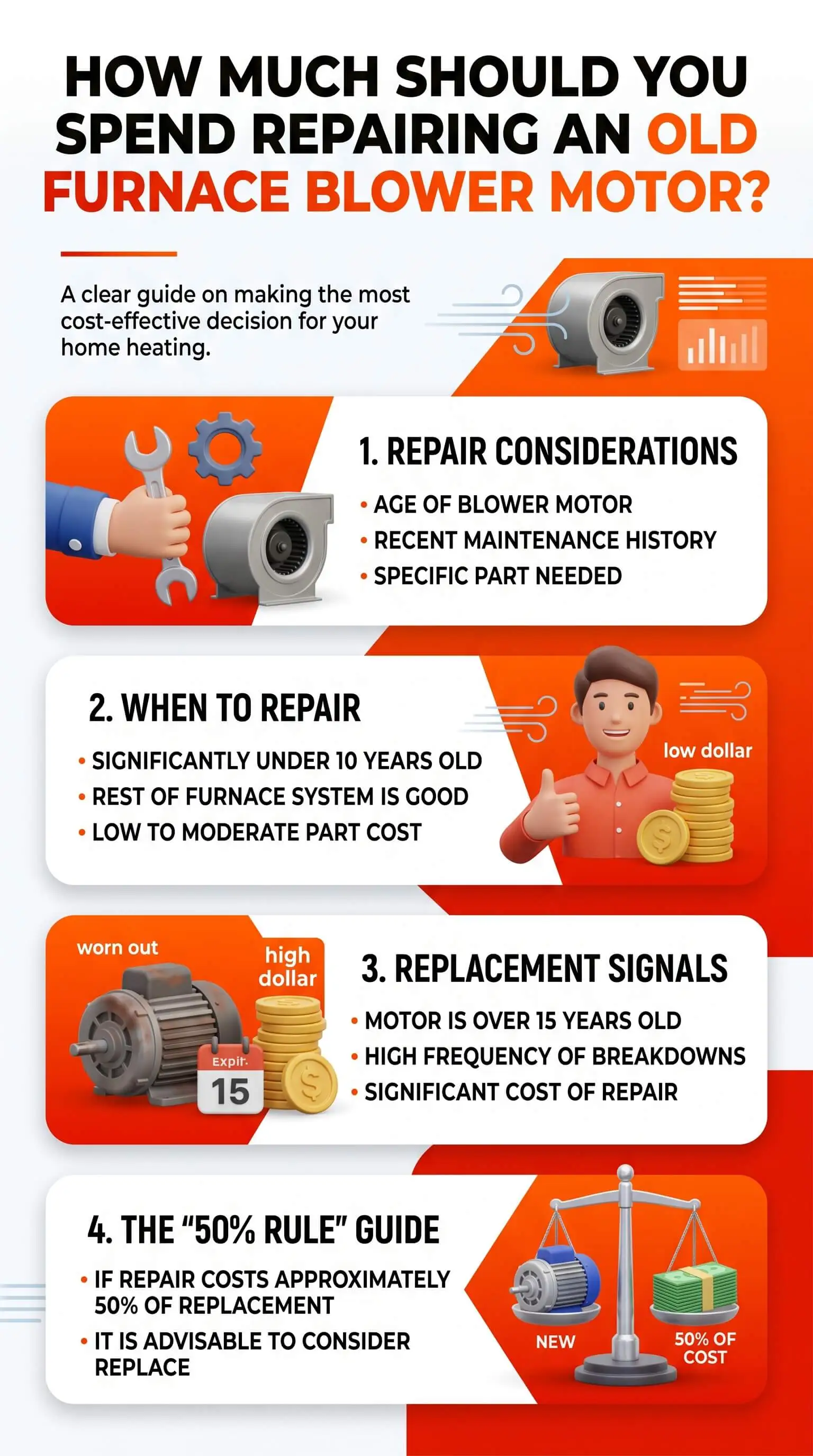
Repair makes sense when: the system is under 15 years old, the failure is isolated, and the quote sits under half the replacement cost.
Replacement makes sense when: the system is past 15 years, AFUE drag has become meaningful, or two or more components have failed inside the last 24 months.
The fast sanity check: when the repair quote exceeds 50% of replacement cost, replacement wins.
Top Takeaways
Most blower motor replacements run $300 to $900 total, parts and labor combined
The 50% rule is the fastest sanity check: when repair exceeds half of replacement cost, replacement wins
PSC motors usually cost less to replace than ECM motors, often by a factor of two to three
System age and AFUE drag pull the math well beyond the motor itself
Restricted airflow is often the root cause. Fix it, or expect the next motor to fail just as fast.
What Blower Motor Repair Actually Costs on an Older Furnace
Most blower motor jobs we run land between $300 and $900 total, parts and labor combined. The motor itself runs $50 to $450 depending on type, with single-speed PSC motors at the low end and variable-speed assemblies at the top. Labor adds another $150 to $400, which usually works out to one or two hours on a clean swap. Emergency or after-hours service tacks on another $100 to $200.
The spread in those numbers is where homeowners get blindsided. Two quotes for the same nominal job can sit eight hundred dollars apart, and contractor markup is almost never the explanation. Across the service calls we run, five drivers account for nearly every gap we see: motor type (PSC versus ECM), brand and part matching (some systems require an OEM motor or a specific replacement kit), accessibility (attic installs and packed mechanical closets eat labor time), related parts (a capacitor, control module, or wiring repair often rides along), and related damage (a clogged filter, dirty blower wheel, or overheated wiring adds scope).
The industry average sits around $560. That's the number we use as a quick sanity check. When a quote climbs well north of $900, ask the technician which of those five drivers is responsible before considering a top HVAC replacement. There's almost always a real answer.
PSC vs ECM: The Motor Type That Changes the Math
The single largest driver of blower motor replacement cost is the motor type itself, and most homeowners don't know which one they have until the technician opens the cabinet. The two designs that dominate residential forced-air furnace systems are PSC (Permanent Split Capacitor) and ECM (Electronically Commutated Motor). Their replacement costs aren't anywhere near each other, and the gap matters when you're running the spend-versus-replace math at the kitchen table.
PSC motors are the older design. They run at one or a few fixed speeds with a capacitor doing the starting work, and they're standard equipment in nearly every single-stage furnace built before the late 2000s. Mechanically they're simple, which keeps their replacement cost lower, often $50 to $250 for the motor itself. The catch is that when a PSC motor fails, the run capacitor has usually degraded alongside it. Replacing one without checking the other sets up an early second failure.
ECM motors took over in higher-efficiency systems starting around the year 2000, and today they ship standard in nearly every 90%-plus AFUE furnace and variable-speed air handler. Their electronic control varies blower speed continuously, which gives you better efficiency and more even comfort across the house. The trade-off lives inside the motor itself: these designs carry a lot more electronics, and manufacturers often package the motor and its control board as a single assembly. That's why ECM replacement quotes can run two to three times what a comparable PSC swap would cost.
When you're running the spend-versus-replace math, the motor type pulls the calculation in opposite directions. A $400 PSC repair on a healthy ten-year-old furnace is usually an easy yes. An $1,100 ECM assembly on a fifteen-year-old furnace deserves a long pause. For warranty coverage, labor versus parts pricing, and the money-saving paths that don't cut corners, the full blower motor replacement cost breakdown walks through every variable in one place.
The 50% Rule and the Age Test
The fastest sanity check we hand homeowners is the 50% rule. When the repair quote exceeds 50% of replacement cost, replacement wins. A $700 blower motor repair against a $4,500 new-furnace install passes the test. A $1,200 ECM assembly on a furnace already due for $1,800 in additional work over the next two years does not.
Age tightens the math further. The U.S. Department of Energy puts older fossil-fuel furnace efficiency at 56% to 70% AFUE, while modern condensing furnaces reach 90% to 98.5%. That gap means a sixteen-year-old furnace burns roughly a third more fuel per unit of heat delivered than a new one, every winter it stays in place. When the blower motor fails on a system that's already losing that much efficiency, the repair money often pays for itself faster as a down payment on replacement than as a patch on what's already there.
The third test we run is the failure-cluster test. When the blower motor is the second or third major component to fail inside twenty-four months, the trend is the answer. One failure usually warrants a straight repair. Two failures inside two years stops being a coincidence and starts being a pattern, and at that point we're often having a different conversation with the homeowner about what comes next.
The Hidden Cost Most Quotes Miss: Airflow
Most blower motor quotes don't talk about why the motor failed, only what it will cost to replace. That gap matters, because these motors rarely die of old age on their own. They die from strain. Restricted airflow, usually from a clogged filter, a dirty blower wheel, or an undersized return duct, forces the motor to work harder and run hotter than its design intended. Most burn out years ahead of schedule because of it. Across the calls we run, the homeowners who change filters on schedule, choose the best furnace filters for home, and keep their return grilles clear get noticeably more life out of the same motor than the ones who don't.
Before approving any blower motor replacement, ask the technician to document filter condition, blower wheel condition, and the static pressure reading at the return. Then fix the upstream cause before you pay anyone to fix the symptom.
“Before we even quote a blower motor job, we pull a static pressure reading at the return. That single number tells us whether the system has been fighting restricted airflow for years. If it has, the motor is the symptom of something further upstream, and replacing it without addressing the cause just sets up another service call in two or three years. The blower motor jobs we see go the longest distance are the ones where we treated the airflow problem first and the motor second.”
7 Essential Resources
Every link below is a primary-source .gov authority, verified live before publication.
ENERGY STAR: Furnaces. Overview of AFUE thresholds, higher-efficiency blower motors, and what certified labeling actually means for homeowners. energystar.gov/products/furnaces
U.S. Department of Energy: Furnaces and Boilers. AFUE definitions, retrofit-versus-replace decision criteria, and forced-air system maintenance checklists including blower service. energy.gov/energysaver/furnaces-and-boilers
ENERGY STAR: Furnaces Key Product Criteria. Formal definitions of Electronically Commutated Motor (ECM) and Annual Fuel Utilization Efficiency (AFUE) as used in federal certification. energystar.gov/products/furnaces/key_product_criteria
EPA: Guide to Air Cleaners in the Home. Federal consumer guidance on HVAC and furnace filter selection, and how filter condition affects system performance. epa.gov/indoor-air-quality-iaq/guide-air-cleaners-home
EPA: What is a MERV Rating? Plain-language explanation of MERV ratings and the airflow-resistance tradeoff that drives long-term blower motor strain. epa.gov/indoor-air-quality-iaq/what-merv-rating
EPA: Should You Have the Air Ducts in Your Home Cleaned? Preventive maintenance guidance on filter changes, duct contamination, and the upstream conditions that protect blower life. epa.gov/indoor-air-quality-iaq/should-you-have-air-ducts-your-home-cleaned
U.S. Department of Energy: Home Heating Systems. Top-level guide to conventional heating system options and the efficiency considerations that frame any repair-versus-replace decision. energy.gov/energysaver/home-heating-systems
3 Statistics
All three statistics drawn from .gov primary sources verified live during Stage 2. Re-verify links immediately before publication.
AFUE efficiency gap between old and new furnaces. Older fossil-fuel furnaces operate at 56% to 70% AFUE, while modern high-efficiency condensing furnaces reach 90% to 98.5% AFUE. The efficiency loss compounds every winter an aging system stays in place. Source: U.S. Department of Energy, Furnaces and Boilers. energy.gov/energysaver/furnaces-and-boilers
Annual energy savings from ENERGY STAR certified furnaces. ENERGY STAR certified gas furnaces in the northern half of the U.S. run up to 15% more efficiently than baseline models and can save approximately $120 per year, with higher-efficiency blower motors contributing to the gain. Source: ENERGY STAR, Furnaces. energystar.gov/products/furnaces
Hidden duct losses outside the AFUE calculation. Duct system heat losses can reach 35% of furnace output when ducts run through unconditioned attics, garages, or crawl spaces. The blower motor carries that load even though the loss never shows up in the system's AFUE rating. Source: U.S. Department of Energy, Furnaces and Boilers. energy.gov/energysaver/furnaces-and-boilers
Final Thoughts and Opinion
We hear the same conversation in different living rooms every week. The blower motor decision rarely sits in a vacuum. It opens up the larger question every homeowner with an aging furnace eventually faces: when does spending on the old system stop making sense?
Our honest opinion after years of running both repair calls and replacement consultations is that the three numbers (repair quote, replacement quote, and system age) almost always settle the question on their own, as long as you let the math do the talking. A young furnace with a clean bill of health and a $400 PSC failure is a repair we make every week without a second thought, especially when the homeowner understands the importance of regular maintenance. The same homeowner with a fifteen-year-old furnace, an $1,100 ECM assembly, and a second component fail in the last year is having a different conversation with us by the end of the visit. By then, what's on the table is the whole system, and the motor is just where the conversation started.
Frequently Asked Questions
How much does a furnace blower motor replacement usually cost?
Most replacements land between $300 and $900 total, including parts and labor . The motor itself runs $50 to $450 depending on type, and labor typically adds $150 to $400 for one to two hours of work. After-hours or emergency service adds another $100 to $200.
Is it worth replacing a blower motor on a 20-year-old furnace?
Usually no, especially when the repair quote exceeds 50% of replacement cost or the system is already showing other failures. ENERGY STAR and the U.S. Department of Energy put typical fossil-fuel furnace efficiency at 56% to 70% AFUE on older units versus 90% to 98.5% on new ones. That efficiency gap often pays for replacement faster than the repair would.
What's the difference between a PSC and an ECM blower motor?
PSC (Permanent Split Capacitor) motors run at one or a few fixed speeds and use a capacitor to start, which makes them standard equipment in most older single-stage furnaces. ECM (Electronically Commutated Motor) motors use electronic control to vary blower speed continuously, which improves efficiency but adds complexity. ECM replacements cost more, especially when manufacturers package the motor and its control board as a single assembly.
Can a dirty filter cause a blower motor to fail?
A dirty filter can absolutely contribute to early failure. Restricted airflow forces the motor to draw harder and run hotter, which accelerates wear on the bearings and windings. The simplest, cheapest way to add years to a blower motor's life is to use a top furnace filter and change filters on schedule.
How long should a furnace blower motor last?
A properly sized, well-maintained blower motor typically lasts 10 to 20 years, often tracking the furnace's own lifespan. PSC motors in older single-stage systems tend toward the lower end of that range, partly because a weak run capacitor stresses the motor and shortens its life. ECM motors in newer variable-speed systems can run longer when airflow stays unobstructed and the system sees routine maintenance.
Run the Numbers Before You Authorize the Repair
The blower motor question almost always has a right answer hiding inside three numbers: repair quote, replacement quote, and system age. Line those three up with the expected furnace replacement cost, run them against the 50% rule, and the decision usually makes itself.
In an article about How Much Should You Spend Repairing an Old Furnace Blower Motor?, it helps to connect the repair-or-replace decision back to airflow maintenance, because an older blower motor is more likely to struggle when a clogged or poorly fitted filter restricts the system. Homeowners weighing whether a repair is worth it can also compare replacement filter options like 21x22x1 furnace filters, 20x20x2 HVAC air filters, and 24x24x2 furnace filters as part of the bigger cost picture, since the right filter size and MERV rating can support cleaner airflow, reduce strain on the blower assembly, and help an aging furnace motor last longer before another repair becomes necessary.